
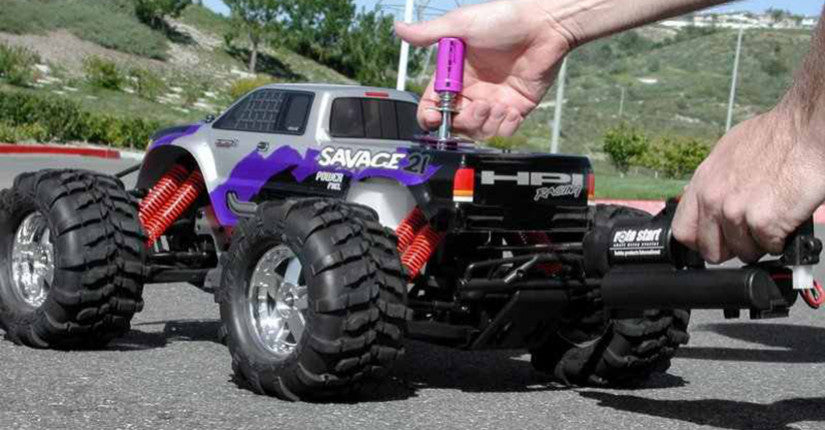
If you've just bought a radio-controlled car but don't know how to start it, then you've come to the right place! Starting a car can be quite intimidating, especially for those new to model building. That's why we've put together this comprehensive guide with three different methods for starting your car.
Before starting
Prepare your tools and your car
The first step is to prepare the equipment you need to start your car. You will need your car, a set of spark plugs, a glow plug heater ( also called a glow starter), a wrench to remove the spark plugs, special RC fuel, anda pipette to pour it cleanly into the tank. You will find all these items in some starter kits.
Once you have everything ready, it is important to familiarize yourself with the layout of your RC car, particularly the location of the launch pull tab, the fuel tank, the resonator, and the spark plug.

Heat the spark plug
Screw a spark plug into its location on the engine, being careful not to tighten it too much so as not to put too much strain on the starter. Once it is screwed in, use the spark plug heater to light it. The spark plug should start to glow, and the brighter it glows, the better.
If the spark plug does not light up, either it is defective or you need to recharge the spark plug heater. It is wise to have a few spare spark plugs on hand, as they can be quite fragile.
Starting with a pull starter
Start the engine
Once the spark plug is hot, it's time to start the engine. The first thing to do is fill the tank with special RC fuel. Some cars have a fuel tank with a push button on top that you can press several times to pump fuel up to the carburetor. If this is not the case, block the carburetor exhaust (to prevent the engine from starting) and pull the starter cord several times. This will pump a little fuel to the engine. This is calledpriming the engine.
Start the engine
The spark plug is hot, the engine is primed, and you are ready to start your engine. To do this, pull the starter cord several times until the engine starts. Be careful not to break your starter cord. We recommend pulling vertically and not too hard (10 cm). maximum) three times in succession. Do not keep pulling the starter cord (if the engine does not start, there is a mechanical problem).
If the starter cord is excessively difficult to pull, this means that you have primed the engine too much and need to deprime it. To do this, simply unscrew the spark plug, turn the car over, and start pulling the starter cord. The fuel nitro should start to spurt out. Continue pulling the starter until no more liquid comes out of the engine.
What to do if the car won't start?
If your car won't start, it may be because your engine is flooded. In this case, you should:
- Remove the spark plug.
- Turn your car over.
- Pull the pull cord.
- Pull until no more fluid comes out.
- Screw the spark plug back in.
- Repeat all the steps from the beginning to start your car.
If your engine is not flooded, you will probably need to make some adjustments to your carburetor. To learn more about how to do this, click here.
Starting with a
starting
bench
Cars without a pull-start system have an opening in the chassis that allows access to the flywheel (check that it is not too high in the chassis, otherwise you will not be able to use the starting bench). The flywheel is activated by the rubber disc on the starting bench. The car can thus be started without a pull cord.
There may be a very slight weight advantage for an engine that starts via a starting bench, as it does not have the additional weight of the pull cord. However, you will need to carry the starter box and have access to a power source for the box (12V battery, rechargeable batteries).

Starting with a roto start
Instead of a pull-start mechanism, a roto start has a small portable electric motor that works a bit like a drill. At the push of a button, it spins the engine to start it. Some combustion engine cars come pre-equipped with a roto start, while other models can be retrofitted with one.

Running in the engine (only the first time)
Once the car is running, it's time to run in the engine. To start running in the engine, simply let the car idle for about 10 minutes. Avoid accelerating for a while so that the oil can circulate properly in the engine.
After waiting 10 minutes, start pressing the accelerator. Acceleration and steering should be gentle car the goal is simply to let the engine warm up and circulate the oil. We recommend emptying two tanks before pressing the accelerator more freely. The spark plug must be replaced after running in, even if it is in good condition.
How do you stop an engine?
To stop a Nitro engine, simply blockthe resonator exhaust. Be careful not to put your fingers car in the resonator, as it may be a little hot. Instead, use a cloth or other object.
When the engine starts, it may run at high speed if the settings are not correct. Some people panic and try to turn it off using the electronic switch. This has nothing to do with the engine. To turn off the engine, you must cover the exhaust hole.