
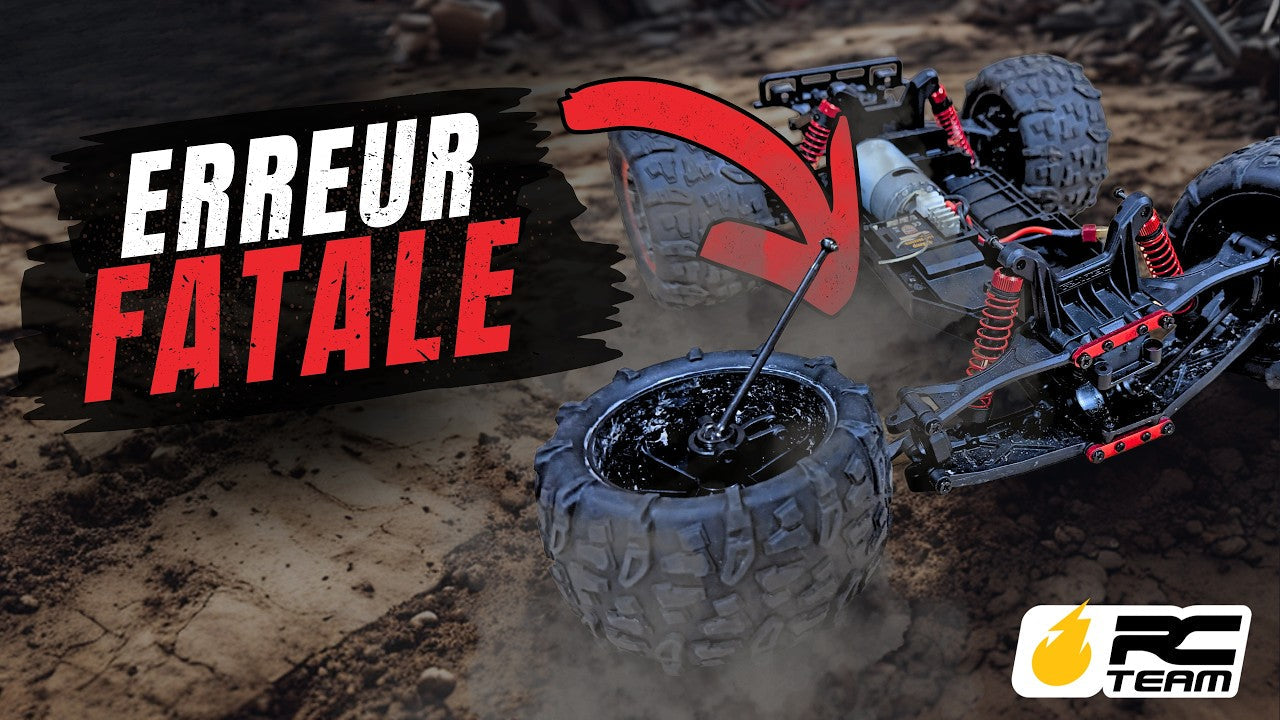
When you decide to get started with RC cars, the excitement of those first few laps of On-road often gets the better of caution. However, to avoid mechanical issues and breakdowns that can quickly discourage you, it’s essential to develop the right habits from the start. To help you drive longer and keep your RC equipment in good condition, we’ve listed the 7 most common mistakes made by beginners in RC modeling.
1. Driving without checking that your chassis bolts are tight
This is a classic mistake: losing a wheel in the middle of a straightaway or thinking you’ve broken your drivetrain when all that happened was a single nut came loose. The vibrations from an RC car are intense. It’s therefore crucial to check that all screws and wheel nuts are tight before every session, especially when your vehicle is new.
2. Neglecting to clean your RC car
Proper maintenance of your RC car is key to its longevity. If you’ve been driving in a dusty environment, a quick blast with an air compressor or a brush will do the trick. However, if you’ve driven through mud, a more thorough cleaning of your vehicle is necessary. Use a suitable cleaning product, rinse with a gentle stream of water while taking care to protect the electronics, then dry it thoroughly. Always finish by applying a lubricant spray to the metal and plastic parts. Caution: Driving through water requires a more thorough disassembly to prevent rust!
3. Incorrect Transmission Adjustment (Gear Mesh and Slipper Clutch)
Your machine’s mechanics require precision. If your model is equipped with a “slipper clutch,” check its adjustment in your manual: if it’s too tight, it will no longer absorb shocks and you risk damaging the transmission; if it’s too loose, you’ll lose all your power. Similarly, checkthe backlash (the space between the Gear motor and the Spur gear). There should always be a very slight amount of play so the mechanism can move freely without wearing out prematurely.
4. Misusing LiPo batteries
The LiPo batteries are powerful but require careful handling. The golden rule for your RC electric car ? Never drain your batteries completely while driving, or you risk destroying them. Additionally, a LiPo battery should never be stored when completely empty or 100% charged (use your charger’s “Storage” mode). Finally, always charge your batteries under supervision and with a -compatible charger with lithium technology.
5. Driving on surfaces unsuitable for your vehicle
This may seem obvious, but no RC car is 100% versatile. Each chassis is designed for a specific type of terrain. Avoid doing big jumps (bashing) with a Crawler designed for slow off-roading; don’t wear out the tires on your Buggy off-road tires on asphalt, and don’t take a Drift car into the sand. Sticking to your car’s preferred terrain is the best wayto avoid damage.
6. Choosing the wrong parts and upgrades
The desire to go faster often leads beginners to install an overpowered motor. The problem? If the stock transmission isn’t built to handle that power, it’ll blow up the first time you hit the gas. The same goes for the steering: installing a small steering servo on a heavy vehicle will cause it to burn out quickly. Before buying upgrades, make sure your equipment is compatible and well-matched.
7. Ignoring minor warning signs and mechanical failures
A radio-controlled car “talks” to its driver. An unusual metallic noise, abnormal play in the steering, or an engine that overheats are all warning signs. Too often ignored, these small details eventually lead to a cascade of mechanical failures, which are much more costly. As soon as you notice something unusual, stop and look for the cause of the problem.
Conclusion
By keeping these 7 points in mind, you’ll significantly extend the lifespan of your equipment, improve your performance on On-road, and save a lot of money. Take care of your machine, and it will repay you on the field!
Have questions about a setting or choosing an upgrade part? Feel free to contact the team of experts at RC Team—we’re here to guide you in your passion for model building.