Among the many types of RC cars available, the Mini-Z series from Kyosho is one of the best. It’s collected by many fans and prized by beginners and seasoned modelers alike because it’s affordable, high-performance, and easily customizable. Another major advantage is the variety of different designs available. If you, too, would like to purchase this Kyosho microcar, then we recommend reading this beginner’s guide to Mini-Z.
Introduction to the Mini-Z from Kyosho
What is a Mini-Z?
Kyosho is one of the oldest model car manufacturers, and the Mini-Z is one of their most recent and popular creations. They introduced the Mini-Z in 1999 as “the first palm-sized RC car.” The wheelbase of these miniature cars ranges from 86 mm to 106 mm—roughly the length of a hand from the little finger to the thumb—which explains why the term “Mini” is included in its name. The “Z” part comes from the fact that it’s an easy-to-handle car that can be completely customized and rebuilt from “A” to “Z.”
Over the two decades since its release, the Mini-Z line from Kyosho has become a must-have among RC car enthusiasts. The vehicles are all of excellent quality, both in terms of performance and appearance. They give model car enthusiasts the feeling of owning a high-performance vehicle at an affordable price.
What is the history of the Mini-Z?
The first chassis that Kyosho created in 1999 for the Mini-Z line was called the MR-01. It was available in three models based on real-world vehicles: the Nissan Skyline GTR, the Mitsubishi Lancer Evo VI and the Subaru WRX.
The second generation of their flagship model, the MR-02, was released in 2004 and underwent major design changes. Notably, the AAA batteries, which were previously installed upright, are now laid flat in the chassis. The Ferrari Enzo was the first model based on this MR-02 chassis.
All of these chassis were equipped with two-wheel drive (2WD). The company’s next major breakthrough was the development of an Mini-Z with all-wheel drive (AWD), which makes drift easier to perform. Instead of MR, the names of these AWD vehicles begin with MA. The first was therefore the MA-010, which corresponds to the AWD version of the MR-01.
More recently, in 2009, the latest generation of MR chassis was released with the MR-03. This This model features several major improvements and is also available in an AWD version with the all-new MA-020.
Why choose a Mini-Z?

For its aesthetics and variety of models
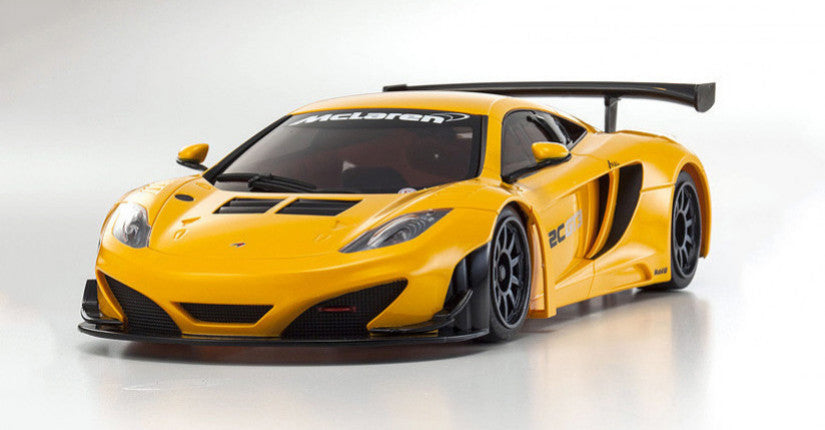
. Despite the amazing performance and capabilities of Kyosho's Mini-Z cars, not all enthusiasts use them for racing. Some place great importance onthe vehicles’ appearance. For these modelers, who are highly attuned to aesthetics, one of the major attractions of the Mini-Z is the number, beauty, and precision of the available body kits and decorative accessories. In fact, they are so well made that many modelers collect only the body kits. The manufacturer thus offers 1/27-scale models inspired by real vehicles (mostly Japanese cars such as Toyota, Subaru and Nissan, as well as other brands such as Lamborghini and Ferrari).
To customize your car
If you like the Mini-Z just the way it is, then go ahead and enjoy it. However, you should know that these RC cars can be extensively customized. Many hobbyists enjoy making a few simple tweaks, while others replace numerous parts to unlock the full potential of these machines. In our online store, you’ll find a wide selection of parts and accessories to customize your Mini-Z car, as well as body kits to change its appearance.
To compete in races
: Some modelers enjoy competing, and even though Mini-Z weren’t specifically built for that purpose, they’re worthy contenders, especially in indoor races. Their top speed is generally 15 km/h but can reach up to 50 km/h with a modified Mini-Z.
Achieving maximum top speed is appealing but not enough; enthusiasts should above all choose cars that are easy to handle, capable of easily navigating very tight turns like those found on small Mini-Z race tracks. The ability to take turns without losing your rhythm is essential to winning an RC race.
The different Mini-Z models

The Mini-Z lineup now includes many different models, each with its own specific features and design. For example, the Mini-Z is equipped with a brushed motor, whereas the Mini-Z VE, which is equipped with a more powerful and faster brushless engine (the latter is more geared toward (competitive). It is also available in the RTR ("Ready to Run") or Readyset for beginners, as well as a kit version for more experienced modelers.
Here is a comprehensive list of the different models and their uses:
- The MiniZ RWD is a micro car RTR (fully assembled and ready to run) with rear-wheel drive (RWD).
- The MiniZ FWD is a micro car RTR (delivered fully assembled) with front-wheel drive (FWD).
- The MiniZ AWD is a RTR micro car (delivered fully assembled) with 4x4 drive (AWD = All-Wheel Drive).
- The MiniZ Buggy is an off-road micro car RTR (delivered fully assembled) with 4x4 (All-Wheel Drive).
- The MiniZ MR03 Evo is a competition-oriented micro car with an engine brushless and rear-wheel drive (shipped without a radio).
- The MiniZ MA-030 Evo is a competition-oriented micro car with a brushless motor and 4-wheel drive (shipped without a radio).
You can choose your model here.
Customize your Mini-Z!

The Mini-Z is a high-performance car suitable for recreational use, but it also has the potential to become a true racing beast by installing various optional parts. For fans of drift, style goes hand in hand with performance, so you can also enhance the presence of your Mini-Z with stylish parts.
Kyosho’s 3 recommendations for the Mini-Z
- Change the tires: Tires are the point of contact between the chassis and the On-road. Like in any other car, they’re an extremely important factor for performance. You’ll find all the tires for Mini-Z here and a guide on how to choose them here.
- Change the shock absorber springs: To improve performance, you can replace the rear springs with a friction rear suspension. You can also adjust the steering by replacing the front springs. Most drivers are used to having a car that understeers slightly. Softer springs allow the car to turn more sharply.
- Change the T-bar: This T-shaped part determines the chassis’s roll. Choose a fiber T-bar for more flexibility or a carbon T-bar for more stiffness.
Kyosho’s 3 recommendations for the Mini-Z drift
- Change the fork legs: The angle of Camber is the angle formed by the tires and the surface of the On-road. It is the most important factor for drift cars. The Mini-Z AWD Sports is equipped with front and rear steering knuckles.
- Install an LED kit: You’ll likely need to drill holes in some body parts, but the process is generally straightforward. When the front and rear lights are synchronized with the throttle, the effect is simply exceptional!
- Install a gyroscope: A car that drift is difficult to control. The gyroscope stabilizes countersteering by detecting chassis movements and automatically correcting the trajectory.
A few other interesting upgrades
- Replace the bearings: The stock bearings are often made of plastic, yet they have a direct impact on the car’s performance.
- Replace the wheel nuts: The stock wheel nuts are often made of plastic and wear out quickly.
- Install a timing chip: The timing chip will allow you to record your lap times.
Learn how to drive your Mini-Z!
The Kyosho training method
The Mini-Z is ideal for riding at home. An indoor training course can easily be set up using water bottles as cones or gates. Simply time your runs. Before that, here’s the training method suggested by Kyosho.
Training around two bottles

Place two plastic bottles about 2 meters apart. Try to ride around them on the outside. This will help you develop your ability to ride close to objects. At first, take it slow, making sure to follow the same path around the bottles. The more you improve, the faster you can go!
Training on a figure-eight course

Once you’ve mastered driving in an “oval,” try driving in a figure-eight pattern around the plastic bottles. If you can do this easily, you’ve mastered the basics. Then design your own training course.
Kyosho’s Training Method for drift
You don’t need much space to practice drift year-round in your garage—all you need is a clear area of about 3 x 2 meters. AWD Mini-Z s usually come equipped with special drift tires, so you can start honing your skills right out of the box.
Practice driving around a cone

Place an object (such as a water bottle) in the center of the space you’ve set aside for the drift. Start drifting by turning the wheel all the way to the right or left, then floor the gas pedal. Gradually return the steering wheel to the neutral position or countersteer if necessary. The car will begin to drift. Try to drive as smooth a circle as possible around the object you’re using as a marker. The more you improve, the tighter you can make the circle.
Practice drifting on a figure-eight course

Place two plastic bottles about 1.5 meters apart. Try driving in a figure-8 pattern, performing a drift around each bottle.
Learning to drift by countersteering

Outside steering = Steering outward / Inside steering = Steering outward
As you approach the turn at a constant speed, quickly turn the steering wheel to the left, then countersteer to the right to make the Mini-Z drift. You’ll need to countersteer at some point to exit the turn in a straight line.
Learn to drift using the throttle

Throttle off = Slow down / Throttle on = Speed up
Approach the turn at a constant speed, briefly ease off the throttle, then accelerate while turning into the inside of the turn to make the Mini-Z drift. Once you’re drifting, you’ll sometimes need to adjust the throttle and/or steering angle to maintain your line.